What is Graphic Design? – Complete Beginner’s Guide

What is Graphic Design?
If we take graphic design from a broader perspective, every object in nature conveys some message through its distinct formation. However, In it’s general usage, the term graphic design refers to creating different visual crafts, including logos, posters, illustrations, brochures, banners, etc.
In today’s world, being a way of communication, graphic design has become a preferred way to connect sellers to their clients. An effective design helps companies to establish their brand image and deliver their core message to achieve their ultimate objectives.
Who is a graphic designer?
A graphic designer can be defined as a professional who creates designs and visuals to communicate ideas and messages. Graphic designers use different design elements to create visual content that is eye-catching, easy to understand, and memorable.
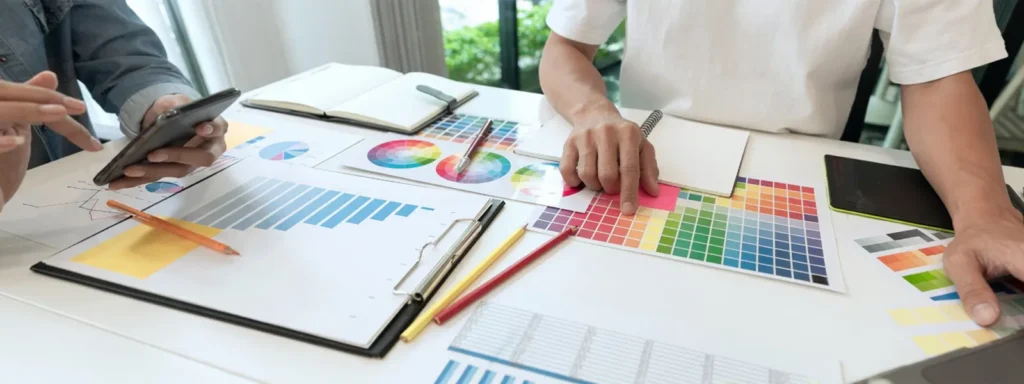
Generally, designers create logos, brochures, flyers, packaging, and posters for businesses and individuals. Designers are not just capable of creating designs but also have strong knowledge of market trends, consumer behaviors, social culture, and a deep understanding of the economy.
What Skills A Graphic Designer Requires
A graphic designer’s work is innovative and creative by nature, so a designer should possess some important personal and professional skills and a deep knowledge of the field.
Let’s go through some of the traits and expertise essential to be an expert graphic designer.
Graphic Design Elements
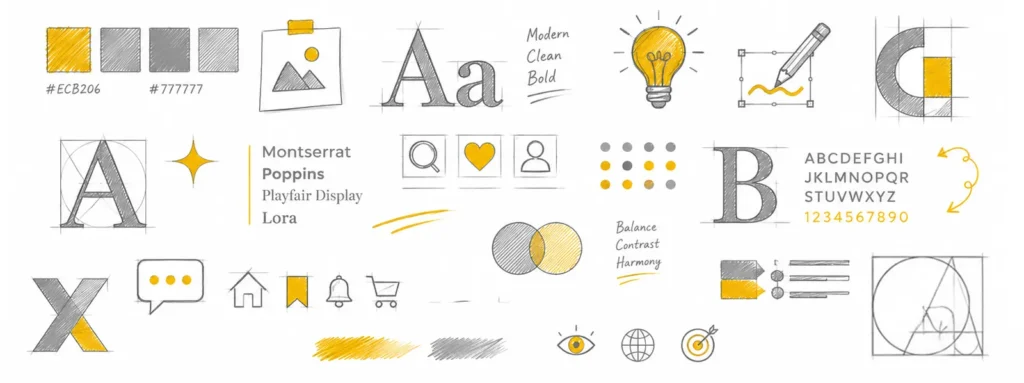
Every design is constructed with some elements used in a particular form and method, depending on the design purpose, core message, and the designer’s personal assessment and choice. A designer decides how he uses different design components like color, shape, typography, and images, considering multiple factors.
Let’s know a bit more about a few of the most commonly used design components:
Color
Colors are not just for making a design attractive and vibrant, but they also depict much deeper meanings. Each color is associated with a particular feel and mood, and represents a specific event and entity. The selection of colors by designers often varies according to their audience’s age, gender, culture, and social beliefs.
Typography
Typography is usually a written form of a language, which can be a single letter, a word, a phrase, an expression, or a complete sentence containing some meaning in it. Similar to colors, different styles and sizes of text content are used to express different emotions and feelings. As languages are different according to their demographic locations and societies, even within different age groups, designers choose the text font, size, case, weight, spacing, and other features accordingly.
Lines
A scientific definition of a line can be “a visible connection between two points is referred to as a line”. However, lines can be straight, curved, angled, or dashed, and of different sizes and thicknesses. Lines are commonly used for defining boundaries of an area or pointing towards a direction.
Shape
Every complex design is built with many basic shapes. Shapes are in the form of circles, triangles, squares, rectangles, pentagons, and hexagons. For new learners, basic shapes provide an easy starting point, and gradually, with an in-depth understanding of shapes, they can become seasoned designers.
Symbols
Symbols are visual objects to elaborate on a complex idea or concept. In other words, symbols are means to convey details through a single object or shape. Symbols are the main elements of graphic design, including icons, logos, religious signs, emojis, etc.
Types of Graphic Design Designers Do

Website Design
Before a website is actually coded and developed, there is a need for a detailed design layout, with color branding, images, typography, and proper spacing and alignment. It provides an opportunity for the client to revise the complete design before it is coded, and makes the development process simple and easy.
Website design is different from other types of designs and requires a deep knowledge of websites, so an expert designer knows about various website layouts, responsive design, web fonts, image optimization, web colors, and screen resolution.
Website development requires following various coding and accessibility standards. So to meet these standards, a designer chooses font size, color contrast, images resolution according to guidelines.
Logo design and Brand Identity
A logo design and brand identity establish a company’s image credibility in its customers’ minds and make it memorable. Designing a logo is not just about creating a visually appealing artwork. It is a strategic process of creating a design that can translate a company’s vision, ideology, and objectives.
A skilled graphic designer conducts a detailed study of a business entity, its potential clients, industry, and competitors when designing its logo or complete brand identity.
Brand identity is a comparatively broader term; it includes logo design itself, as well as defining consistent colors, typography, and imagery, so it can be memorable and recognizable. Designing a complete brand identity is sometimes even more challenging, as it requires more consistency, scalability, and effectiveness across both digital and print media
Design for Advertising
Companies sell their products and services by advertising them on different media. The success of an advertisement depends on how effectively it influences the buyer’s decision and wins their trust.
Again, graphic design is a powerful medium to present a product and service in the most influential way to potential buyers and eventually convert them to actual buyers.
Companies often hire graphic designers to design their advertising materials, such as product brochures, flyers, posters, banners, and billboards, for print media, and for digital media, they design email campaigns, social media ads, YouTube promos, etc.
Magazines and Publications
Magazines and books often consist of multiple pages and follow a particular theme and require continuity from one page to another. These types of designs require consistency and harmony between different sections and topics.
Packaging Design
Product packaging is its first impression and helps to create a unique perception of a product in consumers’ minds. While designing packaging, a designer must consider different marketing factors such as product nature, market trends, competitors, and consumer age group, and various technical features specific to packaging design, including printing colors, bleed area, margins, gluing, and different paper sizes.
User Experience (UX) Design
Increasing use of different interactive devices and media such as smartphones, websites, and video games has increased the importance of UX design in the present age. User experience (UX) design is about accessibility, ease of use, and the responsiveness of a design when users interact with it.
So, UX design scope is broader than other forms of design, as it covers not just the look but also how it operates and reacts. So, UX design is taken as a complete and comprehensive subject, and UX designers need detailed knowledge and solid subject command.
Graphic Design Software
Computer Software | Online Software |
|---|---|
Adobe Photoshop | Figma |
Adobe Illustrator | Canva |
CorelDRAW | Adobe Express |
Affinity Designer | Pixlr |
Inkscape | Kittl |
Sketch | VistaCreate |
Frequently Asked Questions (FAQ)
Summary
Graphic design is a way to convey an idea or concept visually. Graphic designers are professionals who create these designs. Graphic designers are skilled individuals who design visual content using various elements such as color, typography, icons, symbols, and images.
There are various types and forms of graphic design, such as website design, advertisement design, packaging design, brand Identity design, and user experience (UX) design.
Multiple computer software programs and online applications are available to speed up the design process and produce quality designs, including Adobe Photoshop, Adobe Illustrator, Canva, Figma, and many others.